Learning that lasts
A team learns to work together by making something together.
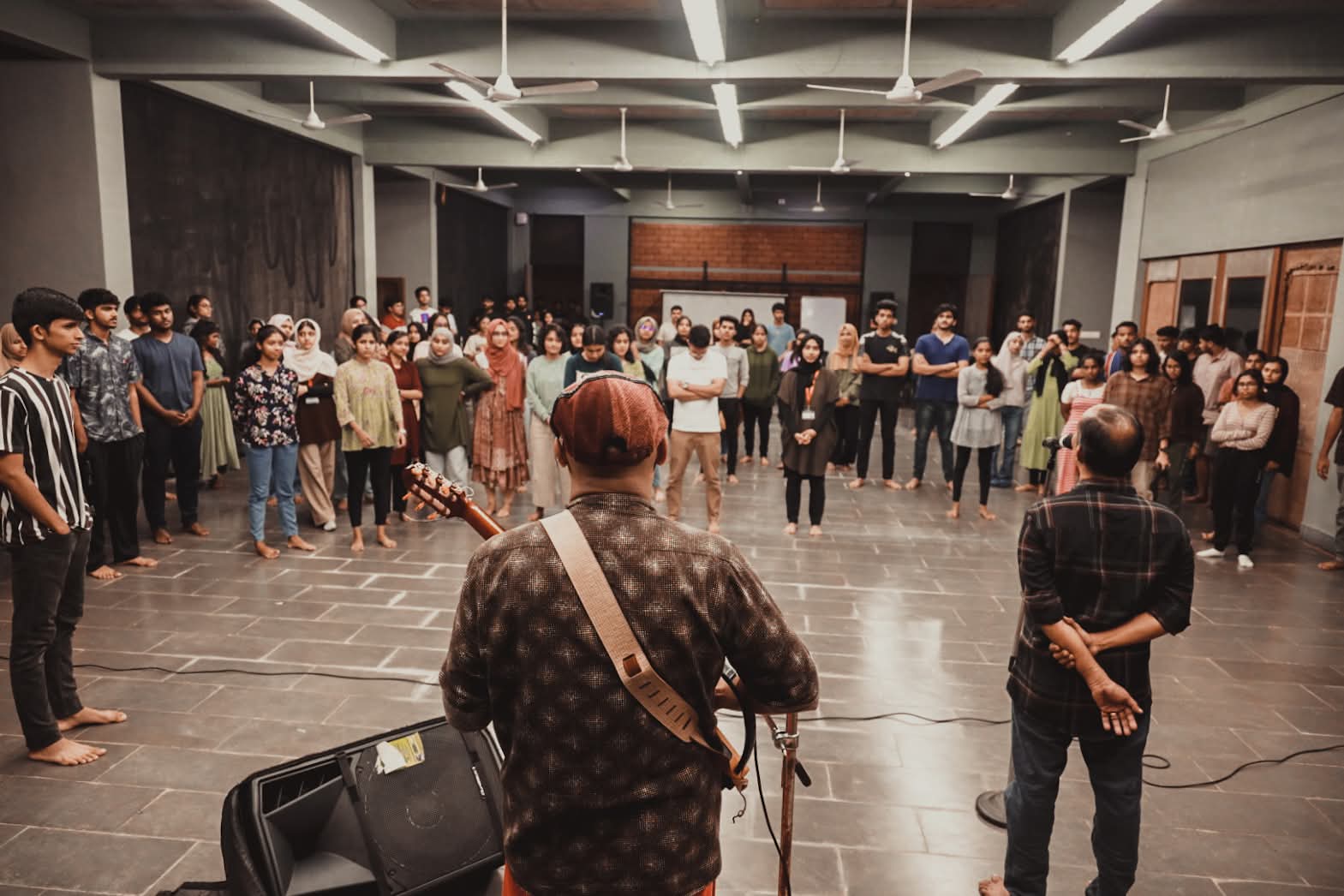
Artfulness is an art based practice for workplaces and classrooms. A room makes music, movement, story or a performance, and in the making it practises what the work outside the room actually needs: listening, timing, collaboration when nobody has the answer, and the nerve to offer an unfinished idea.
What Artfulness Pedagogy is
Artfulness Pedagogy is an arts-based experiential learning framework developed by the Kerala musician and facilitator Saji Oorali. It uses the practices of working artists, primarily music, movement, and ensemble performance, as the medium through which groups learn non-artistic skills: collaboration, attention, improvisation under uncertainty, and psychological safety.
It is not art appreciation, art therapy, or a creativity workshop. Participants are not taught to make art. They are placed inside the conditions artists work in, and the learning comes from what those conditions require of them.
- Where it is practised
- Artfulness is practised in three settings: corporate learning and development, school education under the art-integrated learning provisions of India's National Education Policy 2020, and community arts programming.
- Who it is for
- Teams of any function and seniority, senior management, school teachers, college students, and cohorts of working artists. No artistic background is assumed and nothing is graded.
- How it is delivered
- Live and customised, on the client's own site, by working artists trained into facilitation. Formats run from a ninety minute session to a three day residential.
Nobody types arts based learning. People type the thing that hurts.
So this site is filed under the problem rather than the method. Each question below is one an HR head, a principal, a placement officer or a funder has actually asked us, and each has one honest answer, its name in a budget line, and what we do not claim.
Why does nobody on my team speak up, disagree or admit a mistake?
We promoted our best people into management and now they cannot hold a room. What helps?
Why do our ideation sessions produce a wall of sticky notes and nothing else?
Hybrid work has left us in silos. How do we get people across functions talking again?
Everyone can recite our values and nobody feels them. How do you activate values?
Our people are exhausted by continuous change. What does recovery actually look like?
We bought a wellbeing app nobody opens. What sits between that and clinical care?
Why does training evaporate by Monday, and how would we know if anything changed?
Most training is forgotten inside a week, and most wellbeing programmes are never opened.
Sources: retention benchmarks and industry reporting. Fleming, University of Oxford, 2024, 46,336 workers across 233 organisations.
One practice, held by artists.
The making is the learning.
When a group works out a rhythm they can hold between them, nobody is being prepared to collaborate. They are collaborating, under conditions where failure is instant, audible and shared.
One event, two effects.
The same making produces the safe room and produces the learning. That is why it cannot be replaced by a talk about psychological safety followed by an exercise.
Led by artists.
Holding a room, reading its mood and moving it through an arc is the performer's craft. It is also, exactly, what teaching has always needed.
Between training that ignores state and therapy that reaches almost nobody.
Skill based training.
Builds competence and ignores state. India spends around ₹90,000 crore a year on it, and around 10 percent of leadership training shows measurable results.
Artfulness.
Learning and wellbeing as one mechanism, delivered non clinically, bought as capability building, measured in the language of learning and development.
Clinical therapy and wellness apps.
Real evidence behind the disciplines, but the delivery reaches the unwell and almost nobody else. Employee assistance programmes reach 10 to 20 percent of staff.
Between the two sits the largest group of all. Around 56 percent of adults are neither ill nor flourishing. Training does not serve them, because they are not failing at a skill. Therapy does not serve them, because they are not ill. Artfulness is built for exactly this majority.
Source: Keyes, MIDUS.
Five programmes, built from six learning needs.
Every one of them is customised before it is delivered. The stance does not vary. The session always does.
When was the last time you did something for the first time?
The full arc of design thinking, lived rather than lectured, ending in a prototype tested in front of the room.
പാടി മുന്നേറാം, Paadi Munneram, Let us Sing.
A team writes and sings its own songs, and learns dependability by hearing it in the next bar rather than in a review meeting.
Leader as a performer.
Body, voice and movement, and an intensive theatre process ending in a performed piece with a real audience.
Unwind.
Movement to live ambient music, singing together, the Art Chair, karaoke, and a 90 minute performance to close.
Artist cohort, sustainable art practices.
Artists ideate, prototype and present products built out of their own practices, in front of peers and the hosting body.
Four rooms, one stance.
Schools
Teacher development that is itself art integrated, against the NEP mandate and the CBSE fifty hour requirement.
Schools →Colleges
Ideation and presence for students, including schools of architecture and design, where the studio already works this way.
Colleges →Corporate teams
Learning and development that reaches state as well as skill, bought as capability building and measured as such.
Programmes →Cohorts and funded programmes
Community arts programming and artist cohorts, delivered with hosting bodies and funders.
Artist cohort →We would rather be the honest party in the room.
The case for making over receiving does not come from the arts. Across 225 controlled studies in undergraduate science, engineering and mathematics, active methods beat lecture by around half a standard deviation, and lectured students failed at roughly one and a half times the rate. The full citation trail is published, including the claims we have retired.
What you need is on four pages.
What we do not claim
The eight limits of the claim, stated by us before anyone else states them.
The limits →The evidence
What is well evidenced, what is contested, what we have retired, and what we measure.
Evidence →Saji Oorali
The founder, twenty years on stage, and the Kerala traditions the work draws on.
About →Kochi and Kerala
Where we are based, where sessions run, and three ways to see it before you book.
Meet us first →The fastest way to understand this is to be in a room where it happens.
Eight people, one room, no preparation.